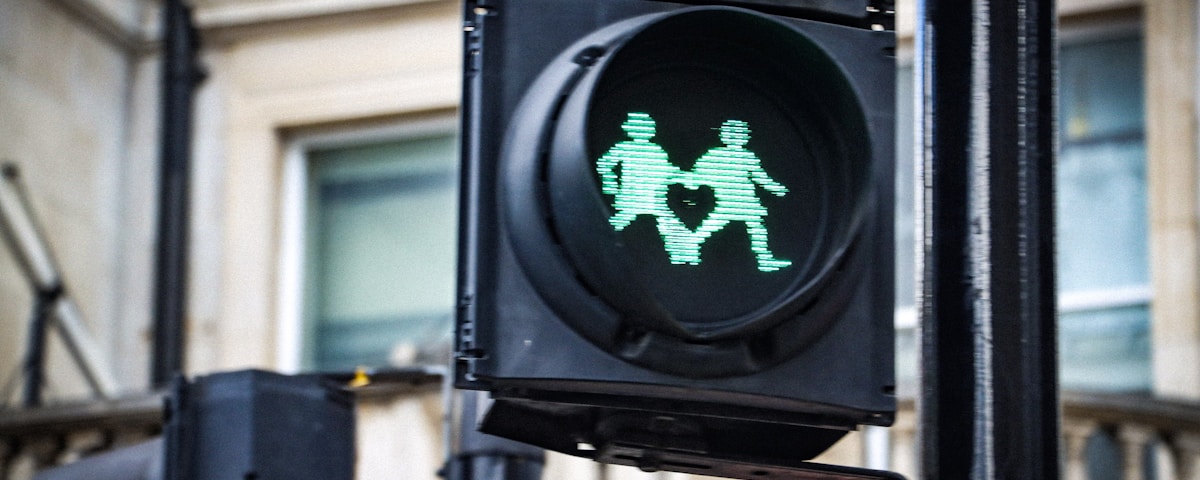
The overlap between CNM communities and LGBTQ+ communities is significant and well-documented. A higher proportion of people in CNM identify as queer, bisexual, or otherwise non-heterosexual than in the general population; and within LGBTQ+ communities, non-monogamy is more common and more normalised than in many straight contexts. This overlap isn't coincidental, it has roots in shared history, shared querying of conventional relationship norms, and practical affinities.
Why the overlap exists
Shared norm-questioning. Coming out as queer, in most contexts, requires stepping outside the dominant narrative about who you should be attracted to and how relationships should work. That process of questioning received relationship scripts often extends to other conventions, including the assumption that relationships must be monogamous. People who've already questioned one fundamental assumption about relationships tend to find it less difficult to question others.
Historical community overlap. Openly non-monogamous communities have historically included disproportionate numbers of LGBTQ+ people, partly because both existed outside mainstream relationship culture. Gay and lesbian relationship cultures, which developed largely outside the institutions of heterosexual marriage, developed their own relationship norms, which for many communities were more accepting of non-monogamy. Queer relationship culture in many urban environments has long included non-monogamy as a normalised option rather than a deviation.
Practical factors for bisexual people. Bisexual people in CNM often describe non-monogamy as allowing them to have relationships with people across the gender spectrum, which satisfies aspects of attraction that a single monogamous relationship may or may not accommodate. This isn't a universal bisexual experience, many bisexual people are happily monogamous, but it's a factor that some describe as relevant to their CNM practice.
Shared and divergent communities
CNM communities and LGBTQ+ communities share significant social and cultural space in many cities, the same events, community organisations, and social networks. In sex-positive and kink communities the overlap is particularly dense.
The convergence has limits. CNM practice is present in heterosexual communities without LGBTQ+ overlap; and within LGBTQ+ communities, non-monogamy is not universal or uniformly valued. There are also specific tensions: gay male communities have historically had their own forms of non-monogamy (open relationships between male partners) that don't always map onto the CNM frameworks developed in polyamory communities.
Shared legal and social challenges
Both LGBTQ+ relationships and CNM relationships exist outside or beyond the legal frameworks designed for heterosexual monogamous relationships. Some challenges are shared: lack of legal recognition for relationship structures outside the dyadic married unit, social invisibility, family rejection, professional discrimination risks.
The legal protection landscape differs significantly, however. Sexual orientation has been more broadly protected in employment and civil rights law in most jurisdictions than relationship structure. LGBTQ+ relationships, having achieved legal marriage recognition in many countries, now have access to legal protections that CNM configurations outside of marriage still don't. The political trajectories are related but distinct.
Queer CNM specifically
Queer approaches to polyamory sometimes emphasise elements that align with broader queer politics: rejection of hierarchical structures that mirror heteronormative family dynamics; explicit attention to power dynamics and their intersections with race, class, and disability; relationship anarchy's explicit rejection of conventional relationship categories as tools of social control.
These aren't universal queer CNM positions, there are queer hierarchical polyamorists and queer polyfidelitous couples and queer CNM practitioners of every configuration. But queer relationship theory has contributed specific analytical tools to CNM discourse, particularly around power and normativity, that have been broadly absorbed into how non-monogamy is discussed.
Navigating both identities
For people who are both LGBTQ+ and in CNM, navigating disclosure often involves managing multiple layers: whether to come out as queer, whether to come out as non-monogamous, and in what order and to whom. In contexts where queer identity is more accepted than CNM (or vice versa), the disclosure calculations are different.
The intersections can also be reinforcing, being out in one dimension sometimes makes the other easier, because the basic process of coming out, managing reactions, and developing one's own sense of what relationships should look like has already been navigated.